Introduction
Have you ever wondered how your phone works? Or how airplanes stay in the sky? Maybe you’ve asked yourself how Wi-Fi travels through the air or how your body fights off a cold. These are the kinds of questions that make life interesting. And learning how stuff works helps you understand the world in a whole new way.
Knowing how things work isn’t just for scientists or engineers. It’s for everyone. When you understand the basics of everyday technology, nature, and science, you feel smarter, more curious, and more confident. Plus, it’s just plain fun to know why things happen the way they do.
In this article, we’re going to explore how stuff works in a simple, friendly, and easy-to-understand way. We’ll cover technology, science, nature, the human body, and more. No complicated jargon or confusing terms—just clear explanations that anyone can follow. Let’s dive in and start learning together.
What Does “How Stuff Works” Really Mean?
The phrase how stuff works is all about explaining the world around us. It’s about breaking down complex ideas into simple, bite-sized pieces that make sense. Whether it’s a car engine, a microwave, or the weather, everything has a reason for working the way it does.
Understanding how stuff works helps you appreciate the science and engineering behind everyday life. It also helps you solve problems, make better decisions, and even impress your friends with fun facts.
The beauty of learning how things work is that it never stops. There’s always something new to discover, something new to understand, and something new to explore. And the more you learn, the more curious you become.
So, what’s the best way to learn? Start with the basics, ask questions, and stay curious. That’s the spirit of how stuff works.
How Does the Internet Work?
The internet is something we use every day, but most people don’t know how stuff works when it comes to this global network. So, let’s break it down.
The internet is a giant system of connected computers. When you visit a website, your device sends a request to a server (a powerful computer that stores website data). That server sends the information back to your device, and voila—you see the website on your screen.
This happens through cables, routers, and wireless signals. Data travels incredibly fast, often at the speed of light through fiber-optic cables. Even though it seems instant, your request might travel thousands of miles in just milliseconds.
Wi-Fi works by sending data through radio waves. Your router receives internet data from your provider and broadcasts it wirelessly so your phone, laptop, or tablet can connect without cables.
Understanding how stuff works with the internet helps you appreciate the amazing technology that connects the world.
How Do Airplanes Fly?
Flying seems magical, but it’s all about science. Learning how stuff works with airplanes helps you understand one of humanity’s coolest achievements.
Airplanes fly because of something called “lift.” The wings are shaped in a special way (called an airfoil) that makes air move faster over the top than the bottom. This creates lower pressure on top and higher pressure below, which pushes the plane upward.
Engines provide thrust, which moves the plane forward. The faster the plane moves, the more lift the wings create. Pilots control the plane using flaps, rudders, and elevators to steer, climb, and descend.
It’s a perfect combination of physics, engineering, and skill. Next time you’re on a plane, you’ll know exactly how stuff works to keep you in the air.
How Does Your Smartphone Work?
Your smartphone is like a tiny computer in your pocket. But how stuff works inside that little device is pretty amazing.
At the heart of your phone is a processor—a tiny chip that handles billions of calculations per second. It runs apps, processes photos, plays videos, and more. Your phone also has memory (RAM) to store temporary data and storage (like a hard drive) for your photos, apps, and files.
The touchscreen uses sensors that detect where you touch. When you swipe or tap, the phone responds instantly. Your phone also has cameras, microphones, speakers, and sensors like GPS and accelerometers.
To connect to the internet, your phone uses Wi-Fi or cellular data. Cellular data works through radio signals sent to and from nearby towers.
Understanding how stuff works with smartphones makes you appreciate the technology you carry everywhere.
How Does Electricity Power Your Home?
Electricity is everywhere, but most people don’t think about how stuff works when they flip a light switch. Let’s change that.
Electricity is generated at power plants, which can use coal, natural gas, nuclear energy, or renewable sources like wind and solar. This electricity is sent through power lines to your neighborhood and then into your home.
Inside your home, electricity flows through wires to outlets, lights, and appliances. When you plug something in, it completes a circuit, allowing electricity to flow and power the device.
Circuit breakers protect your home by shutting off electricity if there’s too much current, which prevents fires and damage.
Knowing how stuff works with electricity helps you stay safe and understand where your power comes from.
How Does Your Body Fight Off Sickness?
Your body is an incredible machine, and learning how stuff works when you get sick is truly fascinating.
When germs like bacteria or viruses enter your body, your immune system kicks into action. White blood cells act like tiny soldiers, hunting down and destroying invaders. Some white blood cells even “remember” germs so your body can fight them faster next time.
Your body also raises its temperature (a fever) to make it harder for germs to survive. That’s why you feel warm when you’re sick.
Symptoms like coughing and sneezing are your body’s way of getting rid of germs. It’s uncomfortable, but it’s actually your body doing its job.
Understanding how stuff works inside your body helps you appreciate how amazing and resilient you really are.
How Do Cars Run on Gasoline (or Electricity)?
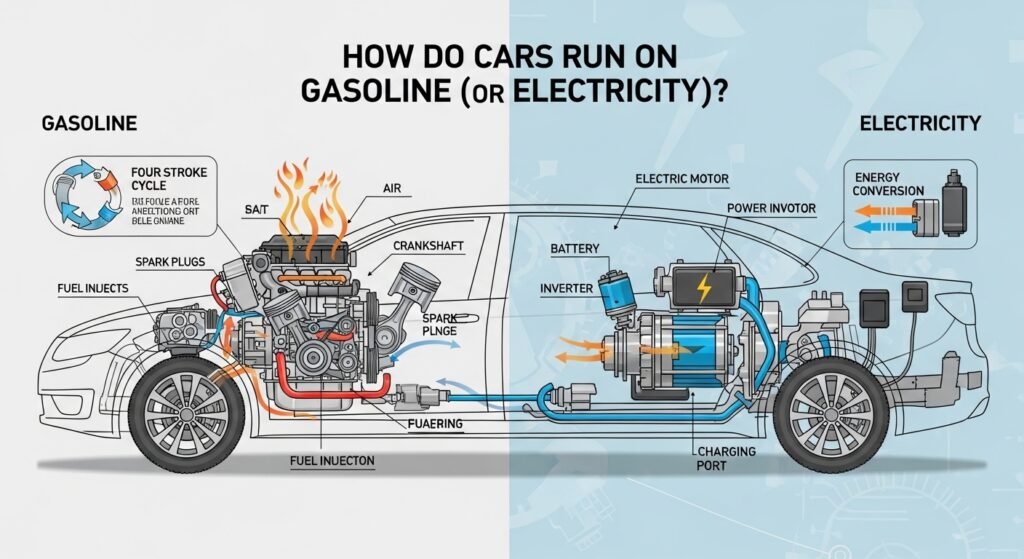
Cars are part of everyday life, but how stuff works under the hood is a mystery to many people.
Traditional cars run on gasoline. The engine burns fuel to create small explosions, which push pistons up and down. This motion turns the crankshaft, which eventually turns the wheels and moves the car forward.
Electric cars work differently. They use a battery to store electricity, which powers an electric motor. The motor turns the wheels directly, making electric cars quieter and cleaner than gas-powered ones.
Both types of cars use brakes, steering systems, and transmissions to control speed and direction. The basic idea is the same—turn energy into motion.
Knowing how stuff works with cars helps you understand the machines you rely on every day.
How Does Weather Happen?
Weather affects our daily lives, but do you know how stuff works when it comes to rain, wind, and storms?
Weather is caused by the movement of air and water in the atmosphere. The sun heats the Earth unevenly, which creates areas of high and low pressure. Air moves from high to low pressure, and that movement is what we call wind.
When warm, moist air rises, it cools down and forms clouds. If the clouds get heavy enough, the water falls as rain, snow, or hail.
Storms happen when there’s a lot of energy in the atmosphere. Thunderstorms form when warm air rises quickly, creating strong winds, lightning, and heavy rain.
Understanding how stuff works with weather helps you make sense of forecasts and stay safe during storms.
How Do Microwaves Heat Your Food?
Microwaves are super convenient, but how stuff works inside that kitchen appliance is pretty cool.
Microwaves use electromagnetic waves (called microwaves) to heat food. These waves make water molecules in your food vibrate really fast, and that vibration creates heat.
The microwave oven has a magnetron, which generates the microwaves. They bounce around inside the metal box until they’re absorbed by your food.
That’s why some parts of your food get hotter than others—uneven heating happens because microwaves don’t always hit every spot equally.
Knowing how stuff works with microwaves helps you use them more effectively and safely.
How Does Gravity Keep Us on the Ground?
Gravity is one of the most important forces in the universe. Learning how stuff works with gravity helps explain a lot about life on Earth.
Gravity is a force that pulls objects toward each other. The bigger the object, the stronger its gravity. Earth is huge, so it has strong gravity that pulls everything toward its center—including you.
That’s why you stay on the ground instead of floating away. It’s also why things fall when you drop them.
Gravity keeps the Moon orbiting Earth and keeps Earth orbiting the Sun. Without gravity, the universe would be total chaos.
Understanding how stuff works with gravity helps you see the invisible forces that shape our world.
How Do Plants Make Their Own Food?
Plants are amazing because they make their own food using sunlight. This process is called photosynthesis, and understanding how stuff works with plants is key to understanding life on Earth.
Plants have special cells that contain chlorophyll, a green substance that captures sunlight. They use that sunlight, along with water from the soil and carbon dioxide from the air, to create glucose (a type of sugar) and oxygen.
Glucose gives the plant energy to grow, and oxygen is released into the air—which is great for us because we need oxygen to breathe.
This process is why plants are so important. They provide food, clean the air, and support life on Earth.
Knowing how stuff works with plants helps you appreciate the natural world around you.
FAQs
1. Why is it important to learn how stuff works?
Learning how things work helps you understand the world, solve problems, and make better decisions in everyday life.
2. Is “How Stuff Works” a website?
Yes! HowStuffWorks.com is a popular website that explains science, technology, and more in simple terms.
3. Can kids understand how stuff works?
Absolutely! With simple explanations and clear examples, anyone—including kids—can learn how things work.
4. What’s the best way to learn how things work?
Start with topics you’re curious about. Read articles, watch videos, ask questions, and stay curious.
5. Does understanding how stuff works make you smarter?
Yes! It builds critical thinking, problem-solving skills, and a deeper understanding of the world.
6. Are there books about how stuff works?
Yes! There are tons of books, websites, and videos dedicated to explaining how things work in fun, easy ways.
Conclusion
The world is full of amazing things, and understanding how stuff works makes life more interesting. From technology and science to nature and the human body, there’s always something new to learn.
You don’t need to be an expert to start. Just stay curious, ask questions, and keep exploring. Every time you learn how something works, you gain a new perspective and a deeper appreciation for the world around you.
So, what are you curious about? Pick a topic and start exploring. The more you learn, the more you’ll want to know.